|
Last Updated: March 27, 2026
If you’ve ever sat across from a client and an open sand tray and thought…
“Now what?” Good. Because that moment--what do I say next?--is exactly where stronger clinical work begins.
Because while sandtray therapy can be incredibly powerful, knowing when to stay non-directive and when to offer a prompt can feel… unclear.
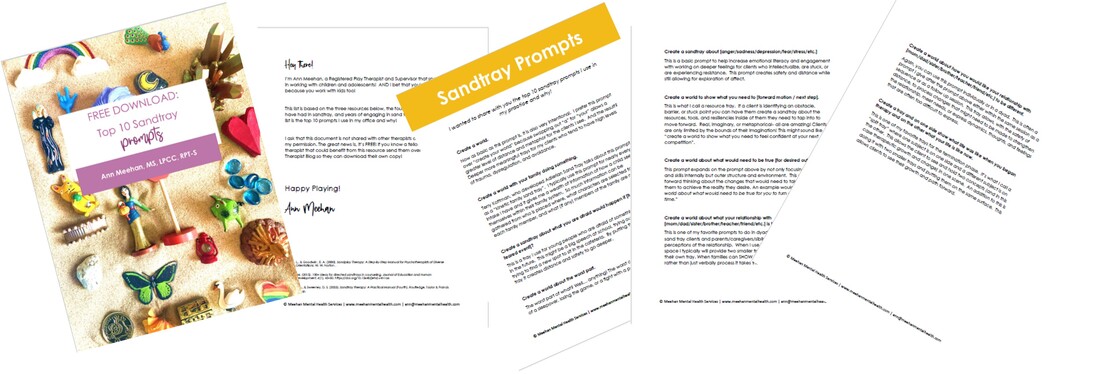
And let’s be honest—those giant lists of sandtray prompts? When you are first starting out they can be overwhelming. Hard to use in real time. And not always clinically intentional. So instead, I’m sharing something different: 10 of my most-used sandtray therapy prompts for kids and teens - this is the free download that will live in your playroom. This is a lamination-level resource.
But first—let’s talk about when prompts actually matter.
What Are Sandtray Therapy Prompts?
Sandtray therapy prompts are intentional directives used by play therapists as instruction for what type of world or scene the child will build in the sand tray. It can be as broad as a general topic OR as narrow as a specific experience or moment in time.
Sandtray prompts can help children:
Prompts are often used more heavily in directive play therapy modalities, but they don’t have to replace child-led work—they support it when needed. RELATED RESOURCE: Why you need more than one tray in your sandtray therapy setup My Go-To Sandtray Prompt (That Most Therapists Overlook)
Real talk?
My favorite sandtray prompt is as simple as it gets: “Create a world.” Now as basic as this is, it is also very intentional. I prefer this prompt over “create your world” because swapping out a for your allows a greater level of distance and metaphor for the clients I see. And the result? Deeper more meaningful trays for my clients who tend to have high levels of trauma, dysregulation, and avoidance. But what about for the kids and teens that are stuck? What about young people that are paralyzed by the wide open space of this prompt? What about kids and teens who have a specific issue they need to go deeper? Well my friend, that’s where sandtray prompts come in! When To Use Sandtray Prompts In Play Therapy
Prompts are especially helpful when working with:
If a client is overwhelmed by the openness of sandtray, a prompt can act as a bridge into the work. And let me tell you - it is absolute play therapy magic when you see the therapeutic shifts that can happen over that bridge. How to Use Sandtray Prompts Without Increasing Resistance
Here’s where many therapists get stuck: prompts can either open the work… or shut it down.
To use them effectively:
Think of prompts as a doorway - not a rigid script or intervention. Because the truth is - sometimes when you give a prompt you are planting seeds for what could be processed. Other times you are reducing resistance and increasing momentum - and the final tray is nothing like what the original prompt was. All of this? Absolutely okay. Which Clients Benefit Most From Using Sandtray Prompts
Sandtray prompts tend to work best for:
They may be less helpful for:
When in doubt - trust your client and follow their lead! Free Download: 10 Sandtray Prompts PDF
If you want 10 powerful sandtray prompts in a simple, printable format for your playroom--
Grab your free 10 Sandtray Therapy Prompts Perfect to keep nearby for:
These are the top 10 prompts I use in my play therapy practice with the kids and teens I see, and the ones I keep going back to again and again. Start using these prompts today and see how much easier—and more impactful—your sandtray sessions can become! Bonus Sandtray Prompts Because I know how powerful a little extra inspiration can be… I’m including two bonus prompts that aren’t in the main PDF. These are the prompts I reach for in tricky sessions—when a client feels stuck, overwhelmed, or resistant—and they often lead to big breakthroughs. Bonus Sandtray Prompt 1: “Create a tray with a hero, a villain, a challenge, and a tool”. This is pure gold for those too-cool-for-school middle school clients who are growing out of nondirective play therapy but are still too old for straight up talk sessions. This prompt adds a little mystery and adventure that is perfect for older kids and teens. It's the sweet spot with just the right amount of structure to not feel too vulnerable but not so much structure that it controls the world and narrative. This is an excellent prompt to assess and work through themes of capability, power, control, and resilience. Bonus Sandtray Prompt 2: “Create a tray with two characters stranded on a deserted island. There are three of their items that washed up on shore. Tell the story of what happened and what will happen next.” This is another prompt that is great for middle school to teen age clients. In my practice and theory I am wanting to know about adaptive information the client holds, how capable they believe they are, where the assign fault and blame, relational dynamics and repair, and sense of resiliency and hope. This is a perfect prompt to identify, process, and work through these related themes. Why Less Is More When It Comes to Sandtray Prompts
It’s tempting to believe that more is better.
More prompts. More scripts. More lists to pull from in the moment. You’ve probably seen them—those massive lists of hundreds of sandtray prompts designed to cover every possible scenario. And at first glance, they feel reassuring. Like, finally—I’ll never be at a loss for words again. But here’s the truth: More options don’t create better clinical work. They often create more hesitation. When your brain is scanning a mental list of hundreds of possible prompts, you’re no longer fully with your client—you’re searching, evaluating, second-guessing. That’s when the doubt creeps in:
And suddenly, instead of feeling grounded, you feel overwhelmed. The truth is, the most effective play therapists aren’t the ones who have memorized the most prompts. They’re the ones who:
That kind of clinical confidence doesn’t come from having more. It comes from going deeper with less. Build Your Personalized Sandtray Prompt List
Instead of trying to learn hundreds of prompts at once, start with a small, flexible foundation.
A handful of go-to prompts that you:
As your confidence grows, your flexibility will naturally expand. Not because you forced it—but because you understand it. Confidence in the playroom isn’t about having the “perfect” thing to say. It’s about knowing how to stay present, curious, and intentional—even when you don’t have all the answers. So my best tip? Start small and build your toolbox. Try a small number of prompts and see how they land for your real clients in your real playroom. Keep the ones that are effective for you and your clients and ditch the ones that don’t align. Over time you will have a perfectly curated prompt list that is the most effective for your playroom! Ready to Use Sandtray with Confidence?
Here’s the truth most trainings don’t talk about:
Having prompts is helpful - knowing how to use them therapeutically is what actually creates change. Because without a clear framework, it’s easy to feel:
Inside Creating Worlds: An Introduction to Sandtray Play Therapy, I walk you step-by-step through:
Click HERE to get instant access and start using sandtray with confidence this week. Loading... *This post contains affiliate links, so I may earn a small commission when you make a purchase through the links on this site. The best news? It doesn’t cost you a penny! Thanks for supporting my business by shopping my favorite playroom gear and accessories!!

2 Comments
|
Hi, there!I'm Ann Meehan, an LPCC, Loading... |